
• Cart: 0 Items
  • Login  or  Create an Account
Menu
  • Home
  • About Us
    • The NUS Press Story
    • Our Award Winners
    • Why Publish with NUS Press
    • For Prospective Authors
    • Our AI Policy
    • Our Open Access Policies
    • Latest News
    • NUS Press in Translation
    • The NUS E-Press
    • Employment Opportunities
    • Our Distributors
    • Contact Us
    • Webstore FAQ
  • Books by Place
    • Singapore
    • Malaysia
    • Indonesia
    • Philippines
    • Mainland Southeast Asia
    • Southeast Asia
    • China
    • Japan, Korea and East Asia
    • Regional / Rest of Asia
  • Books by Subject
    • Anthropology
    • Archaeology
    • Architecture & Urbanism
    • Business
    • Economics & Development
    • Geography
    • History
    • International Law and Legal Studies
    • Language Learning
    • Life Writing
    • Literature & Linguistics
    • Man & Nature
    • Maritime History
    • Medicine & Life Sciences
    • Politics & International Relations
    • Religion
    • Sociology
    • Visual Arts & Visual Culture
  • Books in Series
    • Across the Global South - Built Environments in Critical Perspective
    • Art & Archaeology of Southeast Asia (with SOAS University of London)
    • Asian Studies Association of Australia - Southeast Asia Publication Series
    • Gendering Asia
    • History of Medicine in Southeast Asia
    • IRASEC Studies of Contemporary Southeast Asia
    • Kyoto CSEAS Series on Asian Studies
    • Ridge Books
    • Singapore Studies in Society & History
    • Challenges of Agrarian Transition
    • Studies in Asian Security
  • Journals
    • China: An International journal
    • Southeast of Now: Directions in Contemporary and Modern Art in Asia
  • NIAS Press
  • Account Links
    • Login
    • Create an Account
NUS Press
  • Home
  • About Us
    • The NUS Press Story
    • Our Award Winners
    • Why Publish with NUS Press
    • For Prospective Authors
    • Our AI Policy
    • Our Open Access Policies
    • Latest News
    • NUS Press in Translation
    • The NUS E-Press
    • Employment Opportunities
    • Our Distributors
    • Contact Us
    • Webstore FAQ
  • Books by Place
    • Singapore
    • Malaysia
    • Indonesia
    • Philippines
    • Mainland Southeast Asia
    • Southeast Asia
    • China
    • Japan, Korea and East Asia
    • Regional / Rest of Asia
  • Books by Subject
    • Anthropology
    • Archaeology
    • Architecture & Urbanism
    • Business
    • Economics & Development
    • Geography
    • History
    • International Law and Legal Studies
    • Language Learning
    • Life Writing
    • Literature & Linguistics
    • Man & Nature
    • Maritime History
    • Medicine & Life Sciences
    • Politics & International Relations
    • Religion
    • Sociology
    • Visual Arts & Visual Culture
  • Books in Series
    • Across the Global South - Built Environments in Critical Perspective
    • Art & Archaeology of Southeast Asia (with SOAS University of London)
    • Asian Studies Association of Australia - Southeast Asia Publication Series
    • Gendering Asia
    • History of Medicine in Southeast Asia
    • IRASEC Studies of Contemporary Southeast Asia
    • Kyoto CSEAS Series on Asian Studies
    • Ridge Books
    • Singapore Studies in Society & History
    • Challenges of Agrarian Transition
    • Studies in Asian Security
  • Journals
    • China: An International journal
    • Southeast of Now: Directions in Contemporary and Modern Art in Asia
  • NIAS Press
  • Home
  • About Us
    • The NUS Press Story
    • Our Award Winners
    • Why Publish with NUS Press
    • For Prospective Authors
    • Our AI Policy
    • Our Open Access Policies
    • Latest News
    • NUS Press in Translation
    • The NUS E-Press
    • Employment Opportunities
    • Our Distributors
    • Contact Us
    • Webstore FAQ
  • Books by Place
    • Singapore
    • Malaysia
    • Indonesia
    • Philippines
    • Mainland Southeast Asia
    • Southeast Asia
    • China
    • Japan, Korea and East Asia
    • Regional / Rest of Asia
  • Books by Subject
    • Anthropology
    • Archaeology
    • Architecture & Urbanism
    • Business
    • Economics & Development
    • Geography
    • History
    • International Law and Legal Studies
    • Language Learning
    • Life Writing
    • Literature & Linguistics
    • Man & Nature
    • Maritime History
    • Medicine & Life Sciences
    • Politics & International Relations
    • Religion
    • Sociology
    • Visual Arts & Visual Culture
  • Books in Series
    • Across the Global South - Built Environments in Critical Perspective
    • Art & Archaeology of Southeast Asia (with SOAS University of London)
    • Asian Studies Association of Australia - Southeast Asia Publication Series
    • Gendering Asia
    • History of Medicine in Southeast Asia
    • IRASEC Studies of Contemporary Southeast Asia
    • Kyoto CSEAS Series on Asian Studies
    • Ridge Books
    • Singapore Studies in Society & History
    • Challenges of Agrarian Transition
    • Studies in Asian Security
  • Journals
    • China: An International journal
    • Southeast of Now: Directions in Contemporary and Modern Art in Asia
  • NIAS Press
  • Account Links
    • Login
    • Create an Account
Home > Books > Follow the Maid: Domestic Worker Migration in and from Indonesia
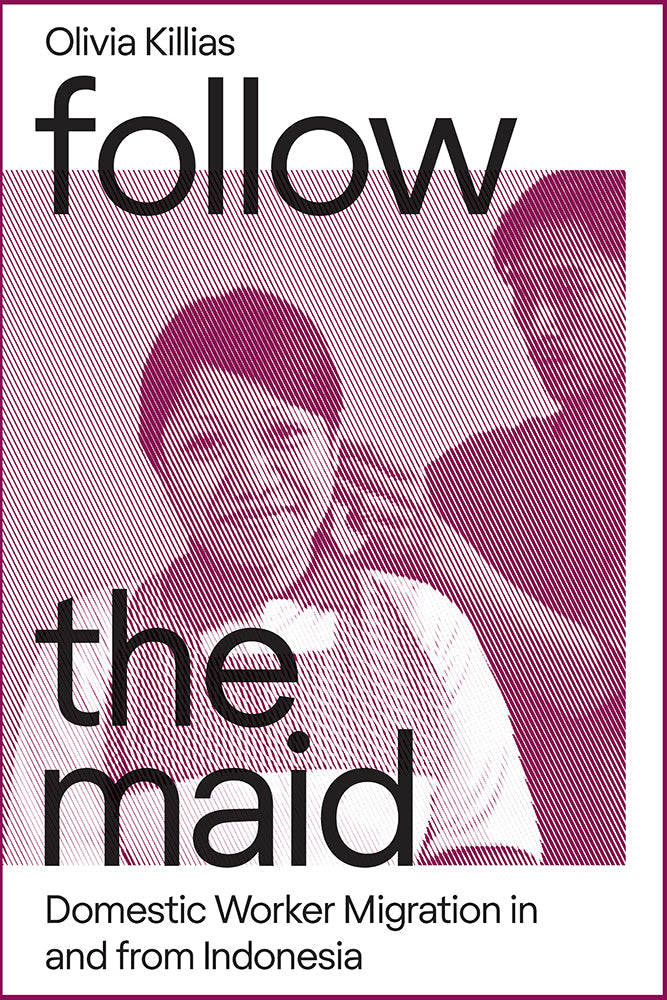
Follow the Maid: Domestic Worker Migration in and from Indonesia

Follow the Maid: Domestic Worker Migration in and from Indonesia

$30.00 SGD

by Olivia Killias

This fascinating study unveils the workings of the Indonesian migration regime, one that sends hundreds of thousands of women abroad as domestic workers each year. Drawing on extended ethnographic research since 2007, the book literally follows migrant women from one particular village in Central Java and tracks the moral, social, economic and legal processes by which they are turned into 'maids’. From recruitment by local brokers to the 'training’ received in secluded camps in Jakarta, employment in gated middle-class homes in Malaysia and back home again, Olivia Killias highlights the implications of the migration process on gendered practices of labour mobility (and immobilisation). She also reveals the disciplinary power that states, recruitment agencies and employers exercise over migrant domestic workers as well as highlighting frictions within the system.

Killias’s analysis demonstrates that ironically, the “legalisation” of the migration industry, under the joint pressures of the Indonesian migration bureaucracy and international humanitarian agencies, does not automatically improve the situation of the women who embark on the migration adventure. Rather, Killias unmasks the gendered moralizing discourses on “illegal” migration and “trafficking” as legitimizing indentured labour and constraining migrant mobility. By exploring the workings of the Indonesian state’s overseas legal labour migration regime for migrants, she brings the reader directly into the nerve-racking lives of migrant village women, and reveals the richness and ambiguity of their experiences, going beyond stereotypical representations of them as “victims of trafficking”.

"Beautifully researched and ethnographically rich, this book literally 'follows' Indonesian women from village, to training camp, to Malaysia, and back again. Acutely attentive to time and place, Killias weaves together compelling narratives and provides important insights into the multi-stranded processes that create contemporary indentured workers." - Nicole Constable, University of Pittsburgh

"This book is a truly remarkable contribution to studies of migrant work and migration regimes in the global South.... It is a study that is attentive to the complex relationships between migration, gender, race, the legacies of colonialism, and forms of regulatory state rule, and is a must-read for anyone seeking to better understand contemporary processes of domestic worker migration." - Juanita Elias, Pacific Affairs

"In the voluminous literature on transnational female migrant domestic workers, Follow the Maid stands out in its ethnographic attention to the process whereby villagers are transformed into migrants. This critical corrective will be of great interest to scholars of gender and migration, in Asia and beyond." - Johan Lindquist, University of Stockholm

Olivia Killias is a senior researcher and lecturer at the Institute of Social Anthropology and Cultural Studies, University of Zurich. She has extended ethnographic research experience in Indonesia, Malaysia, and the Netherlands. Her work has focused on mobility and migration, care and colonialism, aging, memory and urban anthropology.

Publication year: 2017
252 pp / 229mm x 152mm
22 figures
ISBN: 978-87-7694-227-4, Paperback
ISBN: 978-87-7694-226-7, Hardback

NIAS Press

Share Tweet Pin it +1

Latest News

In Memoriam - John Miksic

NUS Press mourns the passing of John Miksic, Emeritus Professor in the Department of Southeast Asian Studies at NUS. A defining presence in the study of Southeast Asian archaeology, Prof...

Quick Links

  • Become an NUS Press Author
  • View our Catalogue
  • Contact Us
  • Webstore FAQ

Newsletter

Follow Us

Copyright © 2026, NUS Press
The NUS Press e-commerce site is hosted by Shopify Inc. in Canada, and is neither developed nor maintained by NUS Press Pte Ltd. When you provide us with personal information to complete a transaction, place an order, arrange for a delivery or return a purchase, we imply that you consent to our collecting it and using it for that specific reason only. If we wish to use your personal information for a secondary reason, like marketing, we will ask you directly for your expressed consent. In using your information, NUS Press will follow our privacy policies, under the provisions of Singapore’s Personal Data Protection Act. But please note that the website is also subject to Shopify’s privacy practices and you are encouraged to examine them before proceeding to share your personal data with us and our 3rd-party partner.